Showing posts with label nutrition. Show all posts

6.01.2012

Guest Post: Career Opportunities in Nutrition

Hi everyone! Today I have another guest post for you from Heather! Heather will be talking to you about some different career opportunities you can take within the health & nutrition field today - something I definitely think is important to know. This is perfect for anyone interested in pursuing nutrition as a full time job. Take it away, Shana!

If you're someone who enjoys looking and feeling good and helping others to do the same, a career in wellness may be right up your alley. Whether you are into eating nutritious food, helping to get the kinks out of someone's sore muscles or pushing people to the peak of physical endurance, you can find an outlet for your interests in an alternative health care career. There are also plenty of career opportunities in the world of traditional health care.

Nutritionist
As a nutritionist, your main job function is to get people to think about the relationship between what they put into their bodies and how they typically feel. Anyone can catch a cold or be down with the flu, but when someone is feeling tired and sluggish most of the time, it's a pretty sure bet their diet is suspect. Most of the time, you will work with clients who seek out your services, such as those who want to lose weight. You may also encounter people in the hospital who don't want to hear what you have to say. In either case, talking to someone about their diet can be a sensitive topic, so the perfect blend between light-heartedness and firmness will be essential in this career.

If you're really into the food and body connection, consider taking your career further and becoming a registered dietician. In this role, you would be responsible for planning menus for schools, hospitals, nursing homes, child care centers or other large institutions.

Personal Trainer

Working as a personal trainer gives you the opportunity to develop close relationships with your clients. They come to you because they want to get in shape and need your help to do it. As you push them to reach their fitness goals, they may claim that they hate you for it, but you should never take such an admonishment seriously. Personal trainers help to hold people accountable for their health and fitness goals when all they may want to do is curl up with a bag of potato chips.

As a personal trainer, you will most likely work for a commercial workout facility, although self-employment is a distinct possibility. With the second option, you may meet clients at your own fitness facility or travel to work with them at their homes.

Massage Therapist
When people get sore from the strains of everyday life or from following an exercise plan, a massage therapist is just the person they want to see. As a massage therapist, you will use a variety of different techniques to help alleviate pain and pressure for your clients. You may be employed in private practice, as a member of a sports organization or in a hospital or nursing home. In order to obtain the best results from massage, your patients typically meet with you on a regular schedule that the two of you determine together.

As a trained massage therapist, you need to be comfortable working with people in an intimate setting. After all, your patients won't feel the effect of a massage very well dressed in a suit and tie.

Traditional Health Care
If you're really into the health field, you don't have to limit yourself to only alternative health practices. There are plenty of opportunities available in traditional health care settings for people who have a desire to help others feel better. Some of the options available to you include becoming a doctor or registered nurse, a nurse's assistant, going into a specialty field like radiology or ultrasound technician and numerous other possibilities.


About Heather


Heather Physioc is the Website Manager for Beauty Schools Directory, a site that matches aspiring cosmetology students with the school of their dreams. Contact Heather or Beauty Schools Directory for all your cosmetology education, licensing and career needs.

5.09.2012

WIAW #25: Tone It Up Nutrition Plan


Aaahhh! It's been so long since I've done a WIAW! I've been WIAW deprived lately and I definitely have not enjoyed it. Now that finals are over and school is out (woohoo I'm a college senior!), I hope to be more consistent with joining the party!

I wish I had purchased the pescatarian option...
This week I have been going through the Tone It Up "7 Day Slim Down" - basically the intro into the diet plan/a way to get fit for a special event - and it's been tough. I'm currently on day 4 and have been doing pretty well, I have to admit, although I have made a few modifications. For example, on day 2 I went out to dinner at The Cheesecake Factory with Stuart. However, I got some really healthy thai lettuce wraps with portabella mushrooms, so I still managed to eat a light meal and not stray too far. My parents also got me a tomato caprese salad when they went to Maggianos, so I at that for lunch and saved a couple slices of the mozzarella to use sparingly on my salad throughout the week. Like I said, not exactly on the "7 Day Slim Down,"  but I think a couple modifications are acceptable. This is the healthiest I've eaten and the most I've worked out in a while so I feel pretty good about it!

For WIAW this week, I'll show you what some of the typical food looks like on the "7 Day Slim Down." Here's what I've been eating, courtesy of Instagram!


Slim Down Scramble - egg whites, spinach, tomatoes, mushrooms, & Mrs. Dash.


Slim Down Protein Pancake - egg whites, vanilla protein powder, ground flax, mashed banana, & blueberries - and half a grapefruit. The second pancake was a little too moist from extra fruit and turned into a yummy scramble!


Salad - with green veggies, balsamic vinegar, a tomato, basil, and a piece of mozzarella cheese (ok I cheated I bit here too)


Groceries - lots of green veggies, fruit, Chobani, beans, hummus, and salad fixings

My workouts have been consisting a lot of the new Tone It Up Beach Babe DVD and this Jillian Michael's DVD:


I also did a lot of running this week for the Flying Pig 5k! 


And guess what? I beat my old time by over 4 minutes (nearly 5)! Yay! I would just like to thank the random woman running next to me who, when I stopped running to walk the final .1 mile, urged me to run the rest of the way. Thank you for your motivation. I would not I have run my best without it! My run time was 34:59, and I was pretty proud of that! I ran almost all of the first mile, and it took me around 10 and a half minutes. I think less, actually. One of these days I'll fun the full first mile without stopping. 

So, my goal is to stick pretty closely to the Tone It Up nutrition plan and lose weight. I need to get back in shape so badly... I went crazy the last couple months of college with not caring much about how much food I ate, what it was, and when I ate. I ate a lot of crap and unhealthy food. I just ate a lot in general. I need to fix that! Also, Tone It Up has really been starving me of sugar and salt so far, both of which I love, so this is a good thing. I've seen pictures of the transformation people can make while on the plan and I hope to be one of those success stories someday in the near future. Let's go Tone It Up! 

I think that's all I have for now. I've been being a major bum this week, lying around my house and petting my puppy. Exactly what I wanted to do before I start my internship & work on the school paper the Newswire office next week :) I really need to unpack still, it is just such a daunting task because there is so much to unpack... *sigh*. 

Here's my question for you this week: How do you keep yourself eating healthy? How do you avoid eating junk food? What do you do for motivation? I guess that is a few questions haha but feel free to pick and choose what you answer! 

Have a great day! 
Much love, 

10.08.2011

Vegan MoFo #8: What's the Deal with Honey?


It's time for the big debate. 

Is honey vegan?


The clear answer is NO, although some vegans do choose to keep honey in their diet. For me, the reasoning behind this is simple: honey comes from bees. Bees are living creatures. They are animals. They are insects. My point? Vegans don't eat animal by-products, and since honey is basically bee regurgitation... why would we eat honey?

The thing is, to most non vegans, the fact that we don't eat honey seems absurd. They understand why we don't eat meat, and they might understand why we don't eat dairy if we explain it to them, but honey? How does it hurt the bees? When I tell people I don't eat honey, they immediately stop taking me seriously. You know why? People don't really understand whats happening. 

First of all, bees are smart. And they can feel pain just like any other animal. Secondly, although there are bee keepers out there who harvest their own honey and treat their bees with care, most honey actually comes from full-time factory bee farmers.


The queen bee is chosen by a human instead of the current queen bee. They typically come from queen bee suppliers - they will ship a queen bee with a few worker bees in a cage to the bee keeper. A new queen is chosen every 1 to 2 years. When a new queen is chosen, the old is killed. The new queen is artificially inseminated (sound familiar? the joys of factory farming and dairy production...). Guys, this is really more gruesome than I thought it would be. CLICK HERE to see pictures of how queen bees are artificially inseminated... it's sad and disturbing. 

Next, in order to manipulate the bees and extract the honey, bee keepers spray smoke into the hive. This causes the bees to eat extremely large amounts of honey and thus become calm, as well as masks the pheromone guard bees release to warn the rest of the colony.  

And no, beekeepers do not just take the "extra" honey. "Commercial beekeepers frequently extract [steal] all fall-season honey and then feed colonies either sugar syrup or corn syrup in quantities great enough to provide all the winter food the bees would need." (Source). So, basically, we steal the honey and feed the bees sugar water so they will stay alive. For Americans, we use about 25 pounds of sugar per year, per hive. So if you're vegan and you eat honey, you're still eating refined white sugar which is typically processed by bone char. Which, we all know, isn't vegan anyways! In the process of taking the honey, some bees are stepped on, others sting the beekeeper and then die, and others die in other ways. 

So really, is eating honey worth it? No, I don't think so. It's still an animal product, and it's not nice to all the bees. Yes, they are animals, but you don't need to go around flaunting the fact that you don't eat honey to your friends, either. If it comes up, tell them why you don't eat honey. Otherwise, why get into an argument about it with someone?

To read the website where I found all of my information, click here.

What are your thoughts on this topic?
Much love,

10.07.2011

Vegan MoFo #7: All About B12


What IS Vitamin B12, that thing that you'll often hear vegans talking about? Why is it so important? What does it do? How do we get it?

Read on!

Vitamin B12 is a water-soluble vitamin that is typically found in animal-based products like meat, dairy, eggs, and fish. It is the ONLY vitamin that is not able to obtained by eating a plant-based diet. Because of this, vegans needs to either take a B12 supplement once daily (of at least 10 micrograms), one a week (of at least 2000 micrograms), or eat food that has been fortified with B12 2-3 times a day (containing at least 3 micrograms). These fortified foods can include plant milks, soy products, cereals, and our good friend nutritional yeast, among other things. Personally, I take a B12 supplement once a day.

 B12 is great for your memory, improving your mood and energy levels, the immune system, slowing aging, preventing heart disease, and weak bones among MANY other things. It is also required for the maintenance and development of the brain, nerves, and blood cells.  Because the human body stores several years worth of B12 in the liver, becoming B12 deficient is extremely rare, but it can still happen. If you are deficient, symptoms may not even appear for five years! Because it's such a slow process, I still recommend taking a supplement to make sure you get enough B12.


Although most vegans get enough B12 in their diet, two groups are especially at risk: raw/macrobiotic vegans (because they do not eat the fortified foods that you can buy) and breastfeeding babies of vegan mommies who naturally don't have much B12.

If you are deficient, you should look for the following symptoms: numbness, reduced sensitivity to pain, loss of energy, tingling, hallucinations, blurred vision, sore tongue, and poor memory, among others. In infants, this may show as a loss of appetite/energy and a failure to thrive. All symptoms can be reversed simply by taking a B12 supplement.

Do you feel you are getting enough B12 in your diet? Do you take a daily multivitamin?
Much love,

10.05.2011

Vegan MoFo #5: All About Nutritional Yeast


Okay. so what exactly IS that daunting vegan commodity, nutritional yeast?


After all, we hear about it all the time. It's a great source of vitamin B12 (and what is that, exactly?! look to a later MoFo post to find out!) and it gives things a slight cheesy and nutty flavor. Which is why vegans love it. This is commonly thrown in vegan mac&cheese for that more realistic mac&cheese flavor. It can also be used in soups, stews, dips, dressings, pasta, wraps,  lasagna... you name it, you can probably sneak some of this bad boy in there. 
So what is it? Nutritional yeast, aka vegetarian food yeast or "Nooch," is NOT the same kind of yeast used in making beer or bread. Totally different. Nooch is a deactivated form of the microorganism Saccharomyces cerevisiae and is made by culturing the yeast with a mix of sugarcane and beet molasses. It is pasteurized and dried to bring out all the nutritional goodies as well as deactivate the actual yeast. Nooch is gluten free and filled with nutritional wonders like B-vitamins (often fortified with Vitamin B12), amino acids, selenium, zinc, niacin, thiamine, and folic acid. It's a healthy powerhouse! 


Try it sprinkled over pizza or popcorn, mash it into potatoes, mix it into a "cheese" sauce, use it to make a breading for tofu or tempeh...there are really an unlimited number of ways to use nooch!


There is one side effect: vibrant yellow pee. Yep, that's right. It's totally normal for your pee to electric yellow after you eat something with nooch in it. And you know what? It's completely okay and normal.  Why does this happen? Well, because nooch contains so much B12 & riboflavin (vitamin B2), the body cannot fully absorb it all. Thus, the excess B vitamins tint your pee! Just think of it as your body thanking you for all the vitamins you're feeding it. 

What do you like to use nutritional yeast in? How do you incorporate it into your diet? 
Much love,

10.01.2011

Vegan MoFo #1: Fighting Colds Naturally


Let's be serious. NO ONE enjoys being sick. Oh wait, you do?


Well, you are weird. :)
But honestly.
Being sick sucks. I mean, who wants to just lie in bed, barley being able to breathe, with a stuffy nose, a headache, and a sore throat?


NOT ME.


So here are some tips and tricks to fight those colds, the vegan way. Naturally and healthfully. Forget the medicine!


But first, how can being a vegan help you avoid sickness?
Well, for starters, a vegan diet is full of vitamins and nutrients. Being sick is a result of your body fighting off toxins in your system, so if you are limiting your intake of toxins by avoiding meat, eggs, and dairy products, you're already on the path to healing. You're eating foods that are good and healthy for you. As long as you don't load up on the sugary vegan junk food and you eat lots of fruits and vegetables, your colds and illnesses will be minimum. A vegan diet will provide with you with tons of cold fighting vitamins, like vitamin A and C, as well as other nutrients like zinc. 


How do you get a cold?
First, you breathe in the cold virus from the air or you touch a surface that has the cold virus on it and then touch your face/nose/eyes. You can also contract the virus by being close to someone who has the virus already. Colds grow in warm places, like your nose, throat, and sinuses, which is why most of the cold symptoms show up in those areas. Once infected, the immune system develops antibodies and mucus to help fight the cold.  Creation of excess mucus is what causes our stuffy noses, coughing, and sneezing. It takes your body about a week to completely rid itself of the virus.


Ready for those tips?
1. Get plenty of sleep.
Seriously. Sleep is the best thing that you can POSSIBLY give yourself while you are sick.  "Those who slept an average of fewer than seven hours a night, it turned out, were three times as likely to get sick as those who averaged at least eight hours. Sleep and immunity, it seems, are tightly linked," says the New York Times. Our bodies need time to heal, so give it time to do so by resting and sleeping away the sickness!


2. Drink lots of juice. Lots. 
Juice is great because it contains of vitamins that can help fight the cold. You know how you're always told to drink orange juice when you're sick? Listen! All that vitamin C and great enzymes... your immune system will be up and running in no time.


3. Squeeze fresh ginger into your hot tea. 
Fresh ginger fights colds like no other. "Consumption of ginger for medicinal purposes is primarily to aid in digestion. It contains calcium, iron, magnesium, phosphorous, sodium, potassium, minerals as well as vitamins A, B complex, and C. Consumption of ginger encourages the gall bladder to release bile, which stimulates digestion. This increases the assimilation of nutrients from the food consumed. Consumption of ginger makes the body feel warm and promotes perspiration. This property is especially useful when a person is suffering from a fever, since perspiration causes a fever to break faster. Consuming ginger is also beneficial if you have a cough, cold or a sore throat." - India Parenting. What else do you need to know?


4. Stay hydrated. 
Because your body needs fluids to flush out all those toxins. And your body needs water to function. Drink lots of tea and water to keep yourself working properly!


5. Eat Drink lots of hot broth. 
Hot liquid is just good for the soul. Miss chicken noodle soup when you're sick? Well, did you know that the reason why chicken noodle soup helps fight colds is because its hot, liquid, and salty? Yep! Drink up that salty broth! 


6. Eat as little as possible.
Seriously. Why eat and introduce more things that your body needs to digest when its trying to heal your body from all the crap you've been eating already? Take this time to eat only the minimal amount of food you need. Your body will thank you, and you will be healed quicker than you could ever imagine. DON'T. EAT. A. LOT.  Thanks :)

7. Get those probiotics. 
Yogurt contains probiotics, which help to keep your immune system functioning and working the way it should. Plus, they aid in digestion. Go drink some GoodBelly or eat some soy yogurt and get those probiotics! 


8. Eat the BRATT diet. 
"What it is: the BRATT diet is prescribed to anyone who is having trouble with digestion, is too ill for heavy foods or simply needs simple, bland foods. BRATT stands for: B-bananas R-rice A-applesauce T-tea T-toast." -From Healthy. Happy. Life. All of these foods are so simple and so vegan! They are great to eat when you're sick just because they are simple. 


9. Stop multi-tasking and just relax. 
Seriously. Stop overloading your body by trying to use your downtime from being sick to get all the homework or chores you need accomplished. It's not worth it. Your body needs rest so it can heal quickly, so give it the downtime it needs. 


10. Take a nice, hot shower. 
Taking a shower opens up your nasal passages and just makes you feel warm and happy all over. Trust me, showering always makes me feel a bit better when I'm sick. The steam is just so refreshing! 


11. Eat vitamin A and vitamin C.
Vitamin A strengthens your body's defenses, while Vitamin C assists your immune system with fighting off the unwanted virus. These are the two vitamins you need to load up on! Vitamin A, "which you get in a form of beta-carotene from foods such as carrots, spinach, mustard greens, kale, yellow and orange squash, to keep mucous membranes soft and moist. This is important, because these membranes, which line the nose, mouth, throat and other parts of the body, are your first line of defense against infections. As long as they moist, they are able to trap viruses and other germs before they get into your system. As a form of double protection, the body also uses vitamin A to manufacture special enzymes that seek and destroy bacteria that manage to get inside the body and vitamin A is critical for preventing infections." Vitamin C can be found in foods like citrus fruits, peppers, guava fruit, dark leafy greens, berries, and broccoli. (Source). Zinc is also really good to eat when sick because it can help keep your white blood cell numbers up so your body can fight off immunity!  


So, are you prepared now to fight that cold? 


What is your favorite thing to eat when you are sick?


Much love, 

9.02.2011

Staying Healthy in College

I have decided that I have a serious problem with eating junk food in college. I love going to the cafeteria and eating salads every day, but when in club meetings or on duty in the RA office, snacks are EVERYWHERE. Especially snacks that are full of hydrogenated, trans-fatty oils. It's hard to avoid, especially when they look so good! Here are the tips I've compiled to help you stay healthy in college - or wherever you are, for that matter.

(Source)

Tip #1: Find a workout buddy.
This is CRUCIAL. Especially if you are working out in the early mornings before class, like I do! I have NO motivation WHATSOEVER to get out of bed unless I know someone else will be waiting on me. Ask around; I'm sure there will be other people who work out in the mornings as well (or whatever time you choose to work out). Personally, I like to work out in the morning because that means the rest of my day is free to think about other things besides getting sweaty and smelly. Get it over and done with. Plus, having someone to go with helps keep you on track. I have a buddy for EVERY weekday, so I'm less likely to slack off and skip a day. It really helps! Try to work out at least 3 times a week for a minimum of 30 minutes each.

(Source)

Tip #2: Eat as many fresh, plant-based foods as possible.
Seriously. A lot of colleges nowadays are becoming more vegan-friendly, especially because being vegan is kinda hip to college kids. Kinda. Not totally. But its catching on! Last year, my campus was NOT vegan friendly at all. This year, we have a WHOLE NEW cafeteria, and it ever has it's own vegan/gluten free station! It's great - it has different types of hummus and salsa, and usually some sort of lentil or bean dish for protein. During RA training, I ate large salads almost every day for lunch. Salads are low in calories and can keep you pretty full. If you make plant based foods the focus of your meals, you'll fill up quickly and be able to eat more for fewer calories. More food, less calories? Come on. This is a no brainer!

Tip #3: Drink LOTS of water.
The new cafeteria recently got a new pop machine where you can add different flavored syrups to your pop and has like 160 different possible flavor combinations. It's ridiculous. Its so cool, yet so bad for you! AVOID THE POP!!! Drink water instead. It keeps you hydrated and doesn't have like 10 teaspoons of sugar in each glass (yucky).

Tip #4: If you're gonna be tempted, don't go near it.
I just don't even walk by the french fry station anymore. I know if I do, I'll grab a big pile of them with lots of ketchup. I don't need those fatty fried foods. They are tasty, but not good you. Since I give in to temptation, I've just chosen to avoid that area at all costs. It's worked so far!

Tip #5: Talk about your lifestyle choices to others.
I've been shocked by the number of people who are really open to the vegan diet and lifestyle in college. I've even found people who tried to go vegan for a while. People really respect those who stick with a vegan diet because they don't have the willpower to do it themselves. Hearing this boosts your self-esteem, ladies (and gentlemen)! You feel good knowing that YOU are doing good, so you keep up with your healthy life decisions. Yeah!

(Source)

Tip #6: Surround yourself with other healthy people. 
Is there a vegan/vegetarian group on your campus? Join it! Have friends who like to run? Go running with them in the morning! You are influenced by the people who are around you, so if you are surrounded by people who constantly eat junk food, you'll eat it too.

5.01.2011

Holistic Nutrition


Earlier this year, I was accepted into a program here at school called TRIO Student Support Services. I applied because they help students in the program pay for college; that was my primary reason for applying was to receive free money. However, there are also a lot of requirements I must fulfill each semester to stay a member of TRIO, including monthly meetings with a counselor/staff member and going to various workshops. My counselor recently told me that I needed to decide what I planned to do with my major after college, and I've been thinking about that question a lot recently.

An English major? Psychology and Theology minors? What do I do with those, exactly?
Well, honestly, I will probably never do anything with psychology. I just minored in it because I enjoyed the classes. As for theology, I could potentially use that if i decided to apply for Navigators Core Team after I graduate. Other than that, I don't see much of a use for that minor either.

English. My thought for this has always been to become a journalist; I would LOVE to be on staff at VegNews, Vegetarian Times, Food Network Magazine, or some food related journalism opportunity. Right now, that is where my decision has stayed. I want my future job to involve writing and food. I would also love to write a cookbook or some sort of vegan friendly book. Anything, really. Or write a novel. Hmmm.

Recently though, I've been regretting my decision to become an English major. I'm not going to lie; Xavier's English program is rather crappy if your future job is not going to involve teaching or criticizing books. I really have not learned anything from my English classes and I have learned more about journalism from being on staff at The Newswire and writing and revising tons of articles. Too bad Xavier doesn't offer a journalism major. They should really get on that.
Hahaha- I love this!

I thought about applying to culinary school for college; I should have done that! I mean, come on, I cook all the time and am constantly reading about nutrition (although that's a more recent development, thanks to recently becoming a vegan). It's so enjoyable. I constantly think about food and eating and health related issues.

So, my recent decision is that I should have gone to college at a school where a culinary arts program or holistic nutrition major existed. The University of Cincinnati has a Culinary Arts program as well as Dietetics and Food & Nutrition programs. And they also have Journalism and English majors. I totes could have double majored!

I've found myself studying holistic nutrition. What is it, exactly? According to www.holisticnutrition.com, it is:

Proper Nutrition is the basis for optimum health and well being. Holistic nutrition is the modern natural approach to developing a healthy balanced diet while taking into account the person as whole. Holistic nutrition is considered to be part of holistic health.
Holistic health is an approach to treating a person’s well being by taking into consideration all aspects of life. A long term course of action includes emotional and spiritual health along with the physical body. Modern medicine focuses on treating a symptom rather than the root cause. If a person is experiencing a symptom or chronic condition, the problem has most likely been developing for some time. The goal of holistic nutrition is to facilitate a health recovery plan as well as build a strong foundation for long term optimum health.

  • Educating yourself on basic nutritional terms
  • Incorporating natural and organic foods
  • Overcoming obstacles in practicing holistic nutrition
  • Creating simple holistic menus
  • Developing a customized holistic diet
  • Addressing the role of natural holistic supplements
  • Reviewing the latest nutritional studies
  • Addressing chronic health conditions with holistic nutrition
Food not only provides the energy needed to function in our daily lives but constantly supplies the nutrients which are required to build and regenerate body tissue, bone, muscle, fat and blood. The nutrients in food are also necessary to produce substances for the chemical processes that take place in our bodies millions of times a day.

Sounds pretty sweet to me. And I totally believe that the way you feel depends on what you eat and how you treat your body. Becoming a vegan has taught me that more than anything.
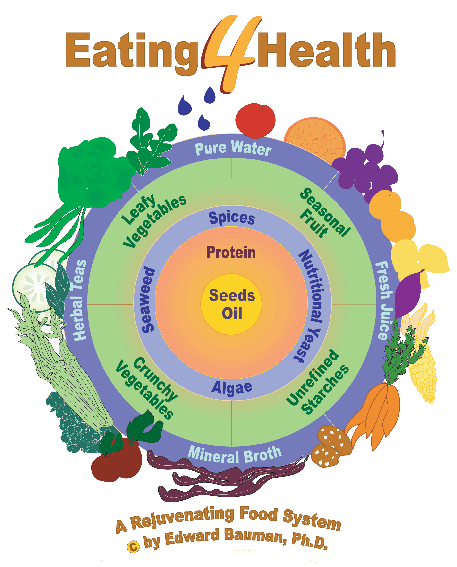
This is a random picture I found from MaryVancenc.com -
it basically just shows the main foods we should
focus on eating!!

Instead of studying for my final exams this week, I have been trying to find somewhere I could take a class in holistic nutrition over the summer. So far, no luck. I might have to buy some books and read up on it instead. But taking classes would look SO much better if I ever wanted to apply for, say, a summer internship at VegNews (English major + food experience + being vegan + educated in holistic nutrition? WINNER!)

Finally, let me say this: I'm not trying to bash my English major. I appreciate it, I love my teachers, and I'm sure my writing has probably improved (even though I've written so many pointless papers on stupid books I can't even tell you). The English major will totally help me land a job in journalism, and my love for food will help me gain the food aspect of food journalism. 

But what should I do after I graduate? (An early graduation, a semester early, is in store for me, I hope!) Go to culinary school at the Natural Gourmet Institute and complete their 5 1/2 month training program? Apply for a VegNews Internship in California? Stay in Cincinnati and pursue a smaller journalism option? Go to college part-time for holistic nutrition? What should I do?! 

Any advice/thoughts?